Transportation

The China and Russia Tourist Visas

The other day, I wrote about the process of securing tourist visas for all of the countries we’re visiting on our trip.  As I mentioned, there were only two visas that required a bit of effort: China and Russia.

We found that the process to secure a Chinese visa requires painstaking detail and precise planning. First off, it should be noted that the Chinese consulate might very well be the least convenient government type building in New York City. While most consulates and embassies are located in cozy brownstones on the Upper East Side or in nice offices adjacent to the United Nations, China has built an imposing fortress at 42nd Street and 12th Avenue. If you’re unfamiliar with Manhattan, that address is close to exactly nothing. And I made the trip out there three times.

Alas, that was just the first of a dozen small hassles that we encountered when applying for a China Tourist Visa. First, the hours of operation listed on the website are wrong. (That’s one wasted trip to the desolate west, west side). Second, it is not clear online exactly which form is needed. And the forms themselves are confusing. For the record, it is the four-page intense questionnaire called “V.2011A”. The forms are known to provide such perplexity that an enterprising team has set up a van just outside the consulate to assist/charge wayward potential visitors. Finally, building security will only let you enter after you show you have all the right documents in hand. We suggest you arrive early because the wait can be up to 90 minutes during busy times.

Once you wind your way to the DMV like window, the staff is curt but incredibly efficient. They expect all paperwork to be ready and they don’t seem to like questions. At one point, the official pointed out that I had not listed where I was staying in China. When I tried to explain that we haven’t scheduled a place to stay yet (“Figuring it out as we go! What fun! Right?”), I was told to come back when the form had an address where were staying. Thank Cupertino for the iPhone, because I was able to look up the address to the Guangzhou Hilton, make a reservation and keep my place in line (avoiding a fourth trip). After a five day processing period during which they kept our passports, our application was reviewed and accepted. Conveniently, you can drop off applications/pick up visas for several people if needed.

Each visa is good for 90 days and is valid for a year from the date of issue (so, in theory, we have till June 2013 to start our visit). Total cost? $140 per person. Ooof! It is all going to be worth it when we step off the plane in Guangzhou and into China! Again, living in New York worked to our advantage because we found if you can’t apply in person at a regional consulate, you must use a private service to secure the visa which comes with a significant additional charge.

The Russia visa was the one visa that just never ended up materializing. It turns out that, loosely translated, Visa means “Bureaucratic Red Tape” in Russian. We’ve learned that wrapping your fingers around a Russia Tourist Visa is trickier that a David Blaine illusion. You must have a sponsor in the form of an authorized hosting Russian traveling agency before you can even apply. And that’s apparently just the beginning of the needed paperwork.

If you’re booking a trip to Russia knowing where and when you’ll be staying (or if you’re part of a tour), this isn’t terribly overwhelming. But if you are flying by the ole seat of your pants, the visa process is enough to make you go cross-eyed. We’ve heard stories of corruption, bribes, and hassles. The more we learned about what we needed, the more complicated it seemed. Lucky for us, we’re visiting St. Petersburg as part of a Norwegian Cruise that offers a variety of Shore Excursions. We were a bit hesitant to book one since that’s not the preferred way we hope to explore new nations, but it appears to be our best and simplest bet for getting ashore.  The cruise line has a blanket visa that covers all passengers…but only for these tours. So, we’ll see a great chunk of St. Petersburg, but unfortunately we probably won’t have any adventurous exploring here.

Our one piece of advice based on our experience with the China, Russia or even Vietnam visa is to research, read and prepare well in advance of a trip to any country that you haven’t visited before. And don’t be afraid if the process seems a touch shady; every country seems to have their own way of doing things. A little knowledge and prep goes a long way to making sure you’re going to get into the countries you want to visit.

-Phil
Categories: Customs, Destinations, Doccuments, New Zealand, Packing, Permits, Transportation, Trip Prep, Visas | Tags: , , , , , , , , , , , , , , | Leave a comment

Choosing Destinations

One of the first questions people ask us when they find out we are traveling around the world is, “How did you ever decide where to go?”  This is a very good question, especially since we have so many options.  The process of choosing where to go involved a lot of research and discussion, but in the end it wasn’t as difficult as we had imagined.

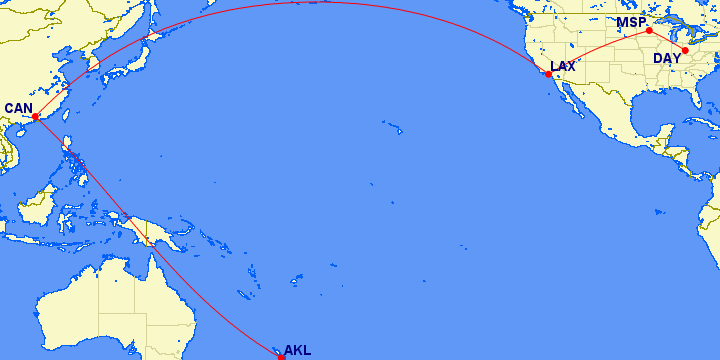
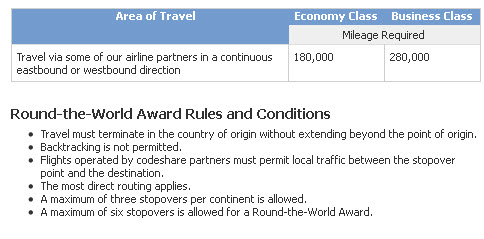
First, you should know that when you buy an Around the World ticket with Delta SkyMiles, there are some limitations.  We are required to go in one contiguous direction with no backtracking.  Next, we can only make six stops.  It is important to note, we can fly into one country and out of another and it only counts as one stop, so it’s more like six “takeoffs and landings”.  Also, you can only stop on a continent twice and the whole trip has to be completed within a one-year time period.

The Chart

Click to enlarge to read the SkyTeam RTW Award Rules…

Now, some people may look at these guidelines as restrictions which prevent free choice and movement.  We found the opposite to be true.  Deciding destinations for an around the world trip is quite daunting and we found these guidelines very helpful in getting us started.  Rather than restricting us, they really helped provide direction and a place to start.

The first thing we had to do is choose which direction we wanted to go.  We decided to go West to East for a couple of reasons.  First, this would have our first stop be in an English speaking country—either Australia or New Zealand.  This would help us ease into our world travels without hitting a major language barrier right away.  Another reason is so we can tackle the Asian countries early on our journey.  We anticipate these countries will provide the most challenging travel experiences due to the vast cultural differences, and we want to explore them while we are still feeling fresh and aren’t so worn down from months of travel.

One of 16 planes we might end up on...

Once we chose a direction, we sat down with a world map and started choosing destinations that the SkyTeam would fly.  We wanted to get the most out of each stop, so not only did we look at the country we would be flying into, but also what other countries we could get to from there.  We knew our first stop would either be New Zealand or Australia—we couldn’t go to both because we only get six  stops.  After asking around, the general consensus was the experience of New Zealand wins over that of Australia any day of the week.

For our European leg, we decided to spend the bulk of our time in Eastern Europe and we are pretty much ignoring western countries like Spain, France and Italy.  The reasons for this are twofold:  the western countries will be fairly easy to get back to in the future and they are so “westernized” that they won’t be as much of a unique experience.  We look forward to trekking through the Balkan states and seeing small villages that seem like they are relics from years past.

Another question we often get is, “Are you going to Africa?”  We spoke to several friends who have traveled extensively and sometimes strangers at parties and they all said the same thing, “Don’t miss Africa.  Go on a safari!”  This is great advice, but you may have noticed Africa is not on our list of destinations.  Here’s why: Africa is far.  Look on the map—to go to Africa and continue in one direction, without missing huge chunks of Europe, would be difficult.  We view Africa and particularly a safari as its own trip.  In addition, we are trying to keep our expenses low and an African safari can be quite pricey.  This is definitely something we’d love to do, we just don’t think this trip is the time.

After going through this thought process together, we then spent about three hours on the phone with a lovely woman at the Delta Rewards Round the World Ticket Desk. (Yes, that actually exists).  We went through each destination, looked for available flights on the SkyTeam, and changed airports when needed.  Luckily, our times are incredibly flexible and so we were able to move things around pretty easily—after all, what do we care if we fly into Buenas Aires, Montevideo or Santiago—they all get us to South America and we can get around from there.

I know everyone has opinions about where we are going and the choices we’ve made, but here’s the thing—we really can’t go wrong.  We chose to avoid areas of the world that we thought might be too dangerous, but otherwise they will all be new and interesting experiences.  Will they all be great?  Probably not.  Will we broaden our understanding of the world and create amazing memories everywhere we go?  Absolutely!

–Brooke

Categories: Destinations, Flights, Transportation, Trip Prep | Tags: , , , , , , , | 1 Comment

International Driver’s License

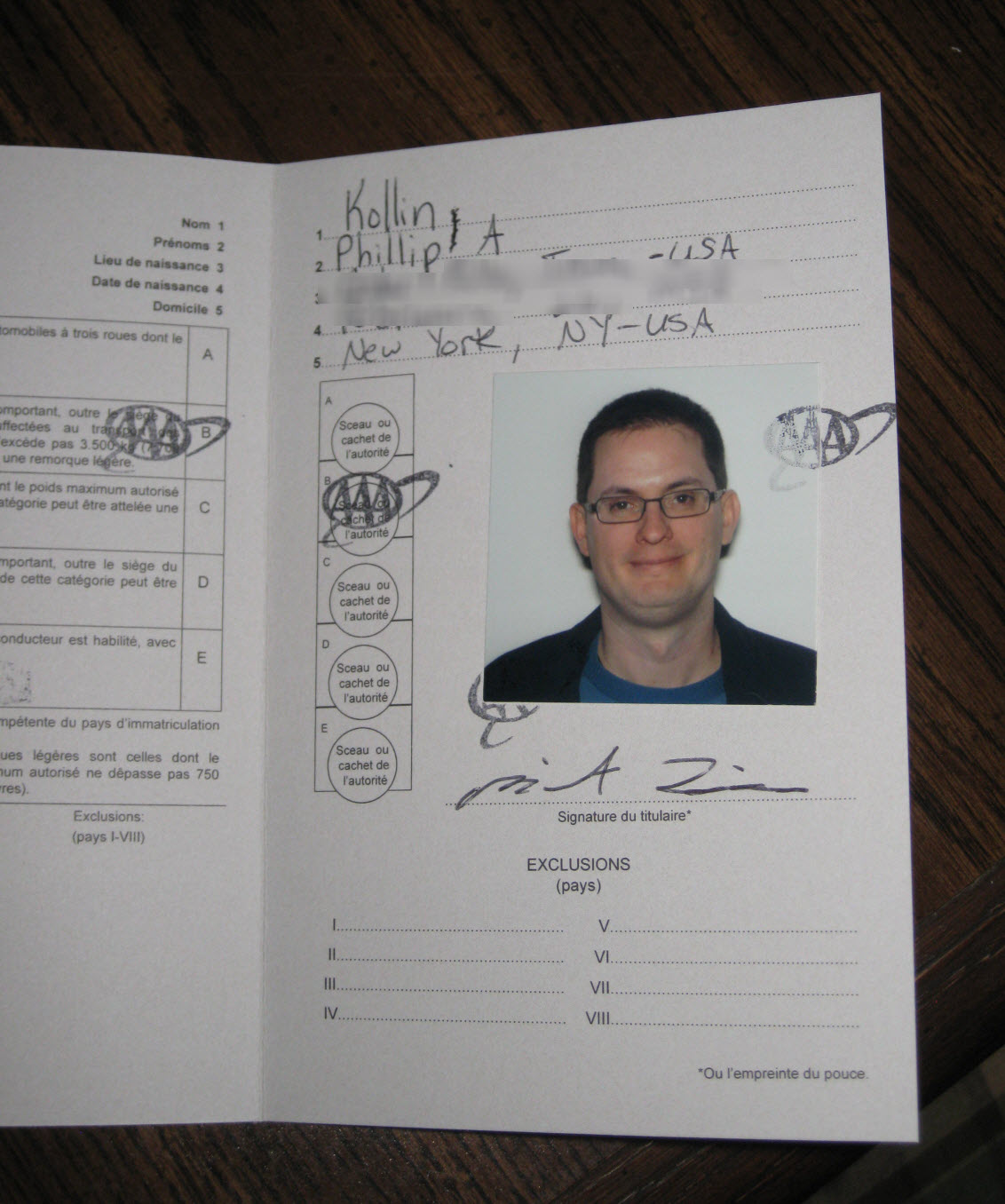
Among the numerous “important documents” that we’ve amassed for our trip, the easiest to secure was the International Driving Permit. Fancy sounding, yes? The permit sounds more impressive than it actually is. I’d love to weave a fancy tale about how getting the license required me to meet up with a strict driving instructor named Sven who insisted I demonstrate International driving technique inside a 1992 stick shift Yugo. The truth is that it was a simple fifteen minute visit to AAA.

International Driver's Permit 2012

First, some background on what the International Driving Permit is. The permit works in conjunction with a valid US driver’s license but cannot be used for driving in the United States alone. The signed & stamped permit contains a number of pages in a number of languages that basically say the same thing: “The owner of this permit is legally certified to drive in his/her country and therefore should be allowed to drive in yours.” Since a car rental office in Ulaanbaatar likely can’t tell a US license from a library card, this gives us some legitimate street cred. The permit is widely recognized and good in over 150 countries.

The permit is good for a year from a start date of the owner’s choosing. The fee is a mere $15.00 and the application process is simple; all you need is a passport photo and your current license.  The permit is about the size of a passport, so a bit too big for the wallet but it is light and folds easily.

There are a few ways to secure the permit in the states, but a visit to a local AAA office is likely the easiest.  I stopped at the only AAA office in New York City a few weeks back. Although my AAA membership apparently expired last year, they were happy to assist. Oddly enough, almost everyone else in the office was also getting the same permit.  It is also odd that there is just one true AAA office in New York City, but that’s neither here nor there.

We’ve gotten some feedback regarding how much we’ll actually need the permit. Some have said that many places will probably just rent to us with our trusty New York state license.  But we subscribe to the better safe than sorry policy. Plus, this can serve as one more Picture ID as needed. We should be all set. Now we just need to get “Life is a Highway” on our iPhone so we can jam as we steer our Yugo down the Romanian Highway.

-Phil

Categories: Doccuments, Driving, Packing, Permits, Transportation, Trip Prep | Tags: , , , , , , , , , , | 2 Comments

Blog at WordPress.com.